
We Are The Terrorists Now
How Trump's use of military force to systematically mass-murder civilians in the Caribbean to coerce the population of Venezuela and affect its governmental policy is terrorism under U.S. law.

Introduction
On September 2, 2025, during an Oval Office event, President Donald Trump announced that he had directed the military to fire on a boat allegedly carrying drugs near Venezuela. Since that day, his administration has disclosed 18 additional strikes using lethal military force against small vessels transiting the Southern Caribbean, resulting in the deaths of 75 people.
The stated objective of this campaign is to kill unarmed civilians who are purportedly transporting drugs to the United States. People not engaged in armed hostilities, not members of any military organization, and who are, at worst, engaged in mid-level felonies for which the typical punishment is 10 years of incarceration. Thus, the reason they are being killed—the alleged commission of a criminal offense—is the same fact that triggers due process protections barring extrajudicial punishment.
Condemnation of these events as a clear violation of the U.S. Criminal Code, the Uniform Code of Military Justice, and the Law of Armed Conflict (LOAC) has come from sources far and wide, from Richard Painter, White House Ethics Counsel under George W. Bush, to John Yoo, author of the infamous “Torture Memos,” to the UN High Commissioner on Human Rights. In fact, it is difficult to find any expert in this area, not otherwise connected with the Trump administration, who can provide a cogent theory of legality.
For its part, the Trump administration has refused to provide anything beyond a vague series of ever-evolving justifications for the strikes, from national self-defense to the contention that America is in an armed conflict with drug cartels it refuses to even identify, which are absurd on their face. It has likewise refused to disclose, or even describe the contents of, an unclassified Office of Legal Counsel (OLC) opinion that it is purportedly relying on to justify its actions.
The only consistent communication from the government comes in the form of social media posts by Secretary of Defense Pete Hegseth, which dress up the strikes with ornamental jargon such as calling the deceased “narcoterrorists” who have “killed more Americans than Al-Qaeda” accusing them of “waging war on our people,” “just as Al-Qaeda waged war on our homeland” and promising they “will be treated the same.” And yet, while each of the social media posts by Hegseth begin with the claim that the boats destroyed were operated by a “Designated Terrorist Organization,” he has named the DTO in only 2 of the 19 strikes.
Which brings us to a fundamental question that Americans must face, no matter how painfully ironic it may be: is the Trump administration’s clearly illegal campaign of mass-murdering civilians to achieve coercive social and political goals itself terrorism under federal law? Yes. It is. On first reading, it may feel, intuitively, emotionally, as if this conclusion resides beyond the last outpost of reason. But that is because we have as a people been conditioned to believe that the United States is a civilized democracy, not a rogue state that dwells on the same low moral plane as Russia and Hamas.
But the facts and law bear no other outcome. And the answer staring back in reflection will be the same, again and again: we are the terrorists now.
How is Terrorism is Defined in the U.S. Legal System and Abroad
The word “terrorism” is defined 16 times in the U.S. Code. Most prominent among these is 18 U.S.C. § 2331, the criminal statute used to prosecute acts of both domestic and international terrorism.
“Terrorism” is defined here as (1) acts that are dangerous to human life that are a violation of criminal law and (2) appear to be intended to either (a) intimidate or coerce a civilian population or (b) influence the policy of a government by intimidation or coercion.
The U.N. Declaration on Measures to Eliminate International Terrorism (1994) and Resolution 1566 (2004) define terrorism as “criminal acts, including against civilians, committed with the intent to cause death or serious bodily injury . . . with the purpose to provoke a state of terror in the general public or in a group of persons or particular persons, intimidate a population or compel a government . . . to do or to abstain from doing any act . . .”
Finally, the Framework Decision on Combatting Terrorism from the European Union (2002) defines terrorism as “offences under national law [including but not limited to causing death or serious bodily injury to a person] committed with the aim of seriously intimidating a population, or unduly compelling a Government . . . to perform or abstain from performing any act . . .”
Regardless of which formulation is chosen, the core elements are the same: criminal acts against the life or safety of a person undertaken with the apparent intent to coerce or intimidate a civilian population or influence government policy through coercion or intimidation.
The U.S. criminal code formulation in § 2331 is the precise one that will be used here, but distinct purposes. First, to measure the Trump administration’s conduct. Second, to dispel the false assertion repeated by Hegseth that common criminals engaged in nonviolent drug transportation over 1,000 miles from any U.S. border are “terrorists” akin to Al Qaeda.
Trump’s Use of Military Force to Mass-Murder Civilians in the Caribbean
The administration began its campaign of using lethal military force against civilian vessels transiting the Southern Caribbean on September 2nd.
In total, there have been 19 strikes, resulting in the death of 75 people, with three individuals who survived the initial attack. Two survivors were detained by the U.S. Navy on October 16th, and repatriated without criminal charges to their home countries of Colombia and Ecuador. The third individual, who survived a strike on October 28th, was designated by U.S. military forces for rescue by the Mexican Navy, but was never located and is believed to have perished at sea.
Trump announced the first strike from the Oval Office, but has typically relied on Hegseth to post information regarding the timing, number of persons killed, and reason for the strikes on X using his nom de guerre “Secretary of the Department of War.” Hegseth’s posts have evolved somewhat, but nevertheless follow a consistent pattern typified by the below from November 1st:
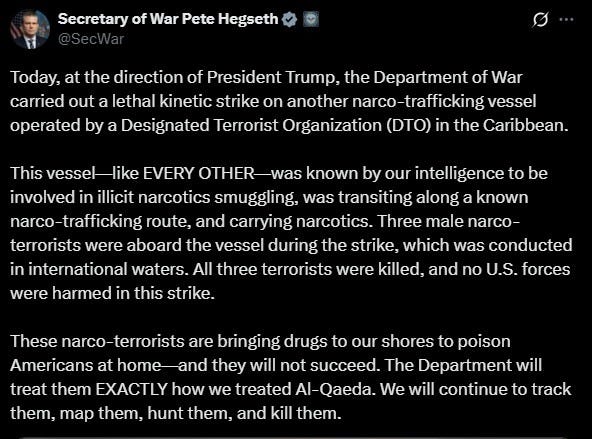
Troubling discrepancies abound. In the first paragraph, he makes specific accusations that suggest knowledge of who we are attacking and the discrete activities they were engaged in. He refers to the vessel as one operated by a DTO that was engaged in “narco-trafficking.” The occupants are described variously as “narco-terrorists”—an operational term that has no basis in American law—or “terrorists.” Most of the time, he provides a general location, such as “the Caribbean off Venezuela” or “the Eastern Pacific.”
Despite phrasing the posts as if he has actual knowledge of the DTO operating the vessel, in only two of the 19 strikes has that DTO been identified by name, on October 19th (Ejército de Liberación Nacional (ELN)) and on October 24th (Tren de Aragua (TDA)). The same pattern repeats as to the identity of the individuals—using the labels “narco-terrorist” or “terrorist” seem to derive from specific knowledge they are engaged in terrorist activity. And yet, none of the individuals falling within this accusation, including the two we treated and released, have been identified by the Department of Defense.
In contrast to the first paragraph, the second paragraph of Hegseth’s posts contain a cornucopia of vague generalizations seemingly offered to infer the correctness of the targeting decision. We are told the vessel was “transiting along a known narco-trafficking route,” “known by our intelligence to be involved in illicit narcotics smuggling,” and “carrying narcotics.” It is unclear if merely being a “narco-terrorist” or “terrorist” is enough to use lethal force, or if they also have to be in the process of allegedly transporting drugs.
The distinction is relevant, because the current legal justification the Trump administration is offering for its Caribbean operations is that the U.S. is in “armed conflict” with as-yet unnamed cartels.1 Under the LOAC, members of the opposing force can be lawfully targeted wherever they exist, regardless of their activities when killed, as long as they aren’t hors de combat, that is, removed from battle by virtue of injury or capture. If what the government is saying is true—that the U.S. is truly in “armed conflict” with cartels and that the persons killed were cartel members—it is irrelevant what they were doing in their final moments.
Unfortunately, the issue isn’t just with the tortured syntax used by Hegseth. More disturbing is the factual record that has developed in the wake of the U.S. military’s conduct of operations. Simply put, the words and behavior are incomprehensible unless one accepts that the Trump administration is being intentionally dishonest and engaging in egregiously unlawful behavior.
No evidence has been publicly released by the administration to support any claim made by Hegseth in his social-media posts, interviews, or public statements. No evidence the boats were involved in drug trafficking, no evidence the individuals killed were “terrorists,” had engaged in "terrorist activity,” and no evidence the vessels were “operated by” a “Designated Terrorist Organization.” Not only is there no evidence that any drugs, if they were present, were in transit to the U.S., the vessels destroyed were incapable of delivering drugs across 1,000 miles of open ocean water both as a matter of fuel capacity and seaworthiness.
The cartels we are allegedly in an armed conflict with have never been named. Just pause for a moment and consider how breathtakingly odd that is: either (1) they don’t know who the cartels are, in which case any attack is a roll of the dice that the wrong people will be killed (a separate legal violation in itself), or (2) they do know, and are lying by omission. Neither scenario has ever occurred in American history. It is also unfathomable how the legal definition of “armed conflict” can be satisfied when the U.S. seems to have no idea who they’re fighting against.2
Furthermore, the treatment of the people killed is wholly inconsistent with their alleged status as members of a hostile enemy force. When two survivors were recovered, the “terrorists” who Hegseth promised to “treat EXACTLY how we treated Al-Qaeda” were immediately sent to their home countries with zero indication they will be detained or prosecuted there. No effort was made to contact, interrogate, or prosecute the third survivor.
The U.S. has never treated terrorists in this manner—claiming they are so dangerous they must be summarily executed—but inexplicably not dangerous enough to place into custody, even temporarily. It also makes zero sense in the context of military operations. Battlefield detainees are a potential goldmine of human intelligence, and that is why the various branches of the U.S. military have entire field manuals and occupational specialties dedicated to their interrogation.3 Failing to exploit a human source of this type puts fellow soldiers in danger and threatens mission success.4
And now, we need not rely on a harvest of suspicions. Over time, a growing body of evidence has emerged. The Associated Press published an article on November 7th highlighting the results of an investigation, based on dozens of interviews, into nine of the 75 people killed by the U.S. military.5 None of the deceased were terrorists, none had engaged in terrorist activity, and none belonged to a DTO.
Also on November 7th, MSNBC published an article based on interviews with family members of those killed, local journalists, and human rights groups, which concluded that none of the victims were terrorists, none had engaged in terrorist activity, and several were fisherman who either weren’t transporting drugs, or were unaware of the contents of their cargo.6 The area where the strikes have taken place, is a route for cocaine, not fentanyl, which is headed not to the U.S., but instead to Europe.
Now put those facts up against Hegseth’s social-media posts. The foundational reason he provided for the campaign of violence is to keep drugs from American shores. The only evidence that exists as of this writing indicates none of the strikes accomplish that purpose. Hegseth also claimed the dead are terrorists. Yet again, the only evidence available shows this too is false. And a similar fate befalls Hegseth’s clear implication that the non-terrorists belong to a DTO.
These concerns were echoed in a bipartisan letter sent to the administration earlier this week from Reps. Don Bacon, R-Neb., Mike Turner, R-Ohio, Seth Moulton, D-Mass., and Jason Crow, D-Colo., requesting further information on the people killed in the strikes. “Cartels often force low-income individuals into maritime smuggling through threats or deception,” they wrote. “What evidence confirms that those killed were cartel operatives, rather than coerced, deceived, or trafficked civilians?”
President Gustavo Petro of Colombia has publicly accused the U.S. of violating its sovereignty and conducting an assassination in connection with the death of a Colombian national, who he claimed was merely a fisherman.7 It is notable anytime such diplomatic rows spill out into the public sphere. But is uniquely jarring when it happens with a nation such as Colombia, once a stalwart ally of the U.S. in the realm of counternarcotics. Indeed, the cooperation between the Central Intelligence Agency and the U.S.-trained military forces of Colombia that resulted in the death of Pablo Escobar is considered one of America’s foreign-policy success stories.
The evidence shows a course of conduct that is plainly at odds with what the administration has told us, and the only way to make any rational sense of their public statements is to assume they are engaging in illegal and dishonest behavior.
Trump’s Effort to Justify the Killings Backfire and Prove their Illegality
Apart from its bombastic, jargon-riddled social media posts, the administration has waged a more formal, private campaign in its dealings with Congress to justify the killings. This effort has come primarily from two written notices, on September 4th and October 2nd.
The September 4th notice was sent under the War Powers Act8, which requires the President to provide a report to Congress within 48 hours of committing U.S. forces to military action.9 The notice begins with a list of societal ills allegedly caused by unnamed drug cartels that are designated terrorist organizations, such as drug addiction in the U.S. and violence in other countries. Nowhere does it state that any of the cartels has engaged in, or is about to imminently engage in, an armed attack against the U.S. In the third paragraph, it claims the September 2nd strike was undertaken as an act of national self-defense.
However, self-defense only applies when a nation is subjected to an armed attack by a hostile military force or there is clear evidence such an attack will imminently occur.10 There has been no accusation from the administration that the U.S. was subjected to an armed attack, or was imminently about to be. At best, it appears their theory might be that somehow the shipment of a product to be used later in a voluntary business transaction (drugs) between Americans and third parties not subject to the Caribbean strikes is a proxy for an armed attack by those killed.
Even if that was the claim being made, it would be farcical, because an “armed attack” embodies “the most grave forms of the use of force” with “widespread scale and effects” such that even localized border encounters between small infantry units involving loss of life do not qualify.11 It must be pointed out that while Hegseth and others have attempted to portray drug overdoses as the product of some intentional aggressive act by those involved in the drug trade, this characterization has no basis in fact or law.
When an American purchases narcotics for personal consumption, they assume the risks with that activity, namely, possible contamination of the drug with fentanyl, allergic reactions, overdosing, and death. This concept is an ironclad feature of American tort law, and has long historical roots. It is beyond absurd to treat the sale of drugs as akin to a military invasion, when the purchaser of those drugs would be be unable to even succeed on a civil negligence claim against the seller.12
Beyond the absence of an armed attack, for an act of national self-defense to be valid, it must also be necessary and proportional. There are no facts, or even accusations, that could possibly support the use of our military to carry out an extrajudicial killing under the principle of national self-defense. And that condemns the entire course of conduct by the Trump administration, from the first strike on September 2nd through to the present day.13
More specifically, self-defense is the principle that governs the initial use of military force, after which the LOAC takes hold and governs the conduct of hostilities. which fall under the rubric of armed conflict. That is the tactic the administration is using in an October 2nd memo to Congress, where it claims to be in an armed conflict with unknown cartels, who it describes as unlawful combatants. Even if that faulty premise were true, the outcome is the same: the Caribbean campaign is a criminal enterprise.
The LOAC principle of distinction bars the targeting of civilians or civilian objects, such as non-military vessels operating in international waters outside of any warzone. As noted in the excellent article by Marty Lederman in Just Security, DoD Directive 2311.01 § 1.2(a) confirms the Department of Defense’s longstanding policy that “[m]embers of the DoD Components comply with the law of war during all armed conflicts, however characterized” but also that “[i]n all other military operations, members of the DoD Components will continue to act consistent with the law of war’s fundamental principles and rules, which include . . . the principle[] . . . . of distinction.”
No matter how you view it, there is no justification present, or even plausible, for the killings of 75 civilians by the U.S. military. Those killings constitute murder under the U.S. criminal code, murder under the UCMJ, and for those who helped planned and took overt acts to complete those offenses, conspiracy to commit murder.14
Calling the victims unlawful combatants doesn’t change the result, but it does provide insight. Using this term is a circular word game that is yet another episode of Trump’s theory of executive power: Article II + unmitigated jargon. There can be no unlawful combatant in a situation where there is no armed attack by an adversary. It is a status that only exists in fully-situated war. While it can’t be stated with certainty, it appears this terminology is being used as some lost artifact from the Global War on Terrorism, which ultimately found its way into the undisclosed OLC opinion.
In much the same way that Hegseth constantly uses the word terrorist and references Al-Qaeda, it is likely that the OLC fashioned some crude theory of legality that analogizes the drone strikes against armed terrorist groups during GWOT to the current situation, but with total disregard of facts on the ground. To be clear, if that is the case, any the effort will fail.
There is no rational parallel between a few fishing boats that might, at worst, be carrying a few kilos of cocaine that Americans voluntarily purchase and a 20-year worldwide conflict that involved the occupation of two countries, combat with several organized military forces, and the deaths of thousands of American soldiers. When 9-11 occurred, that was an armed attack that triggered an armed conflict. Neither of those conditions exist.15
The distinction between then and now, as John Yoo recognized in an Washington Post op-ed, is fundamental to the dividing line between law enforcement and war. “The U.S. has long considered drug trafficking a matter for the criminal justice system. The difference in purpose dictates different tools. The FBI and the Drug Enforcement Administration — not the U.S. armed forces — have prime responsibility for interdicting drug smuggling.”
Using Mass-Murder for Coercion, Intimidation, and Policy is Terrorism
The only terrorist in the Caribbean equation is the United States. Illegality of the mass-murder of civilians having been clearly established, the sole issue remaining is whether it appears those killings may have been committed with (1) the intent to coerce or intimidate civilians or (2) affect the policy of Venezuela’s government through intimidation or coercion.16 The answer is an emphatic yes. Just look at their own words.
On September 17, 2025, while giving a speech to a crowd in Michigan, Vice President J.D. Vance commented on the boat strikes. He recalled a conversation with Hegseth, in which he said, “We don’t see any of these drug boats coming into our country. They’ve completely stopped.” “I said, ‘I know why,’” Vance explained as he was met with laughter.17 “I would stop too. Hell, I wouldn’t go fishing right now in that area of the world.”
Then there is the President himself, the Commander-in-Chief of the U.S. military, who said on September 21st the following to reporters while on Air Force One: “There are no boats in the water anymore. You don’t even find a fishing boat, you don’t even find cruise liners anymore. There’s nothing in the water near Venezuela.” He made similar remarks later on October 15th during a press conference, stating “If you want to go fishing, a lot of people aren’t deciding to even go fishing.”
These are admissions that the administration’s intent with the strikes is at least in part to coerce or intimidate the civilian population of Venezuela—80% of whom live below the poverty level—away from conducting lawful maritime activities they need to survive. There is also clear evidence, direct and circumstantial, that the administration’s intent with the strikes is to affect the policy of the government of Venezuela through intimidation or coercion, namely, to effectuate regime change.
During that same October 15th press conference, Trump said that Maduro had offered his country’s resources in exchange for a deal because “he doesn’t want to fuck around with the U.S.” At several points, Trump has made clear through bellicose language that he is seeking regime change, saying things such as “his days are numbered.”
News reports have indicated that there is a strong push within the administration for regime change, especially from Secretary of State Marco Rubio and that the boat strikes are part of an effort to pressure Maduro into leaving office. Soon after his inauguration, Trump doubled reward for capturing Maduro to $50 million dollars. And this all comes amid a massive military building in the Caribbean involving approximately 20% of the U.S. Navy’s surface fleet, spread across submarines, guided-missile destroyers, amphibious assault ships, and potentially an aircraft carrier, along with 10,000 soldiers.
While the administration has claimed this is a counternarcotics strategy, this makes no sense, as the weapons deployed, from F-35s that cost $30,000 per hour to operate to nuclear attack submarines and Tomahawk cruise missiles, have little utility in the context of drug interdiction. Viewing the totality of the circumstances, experts believe that the boat strikes, the military buildup, the doubled reward and the messaging from the administration are part of an overall strategy to bully Maduro into leaving office, and to increase pressure against him from the civilian population to that end.18
These facts all point to a conclusion that the apparent intent of the administration in conducting the boat strikes is therefore also aimed towards affecting the policy of the Maduro regime through intimidation or coercion. Every element of the U.S. terrorism statute is therefore satisfied based on the publicly-available evidence. That makes us, the United States of America, the terrorists now.
The administration has stated in general terms it is in an armed conflict with the unknown cartels. It has by no means provided any specificity as to how the sale of a product that Americans voluntarily purchase with knowledge of its risk constitutes an armed attack.
Unless of course the administration knows who they’re fighting against but is lying by omission. It is a severe state of affairs when the better answer in the context of killings by military force is that you hope your government is lying.
U.S. Army Field Manual 2-22.3 - Human Intelligence Collector Operations. The MOS for human intelligence (HUMINT) in the U.S. Army is 35M, Human Intelligence Collector, and in the U.S. Marine Corps, it is 0211, Counterintelligence - Human Intelligence Specialist.
As a partially hypothetical example, in 2003, the Taliban used a man-portable air-defense system (MANPAD) to shoot down a CH-47 Chinook over Helmand Province, Afghanistan, leading to the deaths of seven soldiers. This demonstrated that the Taliban possessed far more sophisticated air-defense capabilities than previously recognized. The interrogation of an enemy prisoner of war (EPW) could have revealed this capability and saved lives. For more information: https://www.theguardian.com/world/2010/jul/25/afghanistan-taliban-missile-strike-chinook
https://apnews.com/article/trump-venezuela-boat-strikes-drugs-cocaine-trafficking-95b54a3a5efec74f12f82396a79617ea
https://www.msnbc.com/msnbc/news/exclusive-dozens-killed-us-boat-strikes-remain-unidentified-rcna242339
Section 2.11 of Executive Order 12333 contains an Assassination Ban that prohibits any person employed by or acting on behalf of the U.S. from engaging, or conspiring to engage in, assassination.
It is notable that less than a month later, the administration claimed the War Powers Act did not apply at all, based on the discredited legal theory that U.S. personnel were not “at risk” because the targets were struck from a distance, at stand-off ranges. Anyone who has served in combat knows this is disingenuous. The preparatory work for combat, far from enemy fire, is still exceedingly dangerous. The USS Forrestal aircraft carrier endured a massive fire that killed 134 and injured 167 on July 29, 1967 as it was preparing aircraft for combat operations. The incident was caused by a defective Zuni rocket that shot from a loaded aircraft into others then present on the flight deck. This was one of the top-five most deadly 24-hour periods of the entire war, and it occurred outside the range of enemy weapons. There is also always a risk when conducting aircraft operations.
Copy available here: https://warpowers.lawandsecurity.org/reports/20250623a/
Article 51 of the UN Charter: https://legal.un.org/repertory/art51.shtml
https://opil.ouplaw.com/display/10.1093/law:epil/9780199231690/law-9780199231690-e241
Such a claim would likely be barred on public-policy grounds, but the hypothetical is nevertheless instructive.
The U.S. military, consistent with International Humanitarian Law and the LOAC, categorizes persons who may be encountered on or near the battlefield into four categories: (1) combatants (lawful and unlawful); (2) noncombatants (medics and chaplains); (3) civilians; and (4) unprivileged belligerents. The administration has designated the victims of its missile strikes as unlawful combatants.
https://www.justsecurity.org/120296/many-ways-caribbean-strike-unlawful; 18 U.S.C. § 1111(b); 10 U.S.C. § 918; 18 U.S.C. § 956(a)(1).
To the extent the administration tries to argue that TDA is acting as an arm of the Maduro regime, that was rejected by an intelligence assessment released in April of 2025. https://www.nytimes.com/2025/03/20/us/politics/intelligence-trump-venezuelan-gang-alien-enemies.html
Under this framework, it is not necessary that the killings actually changed the behavior of civilians or altered the policy of Venezuela’s government. It is also clear that a mixed-motive does not insulate the behavior, meaning, if the administration had a motive that satisfies the intent element of the terrorism statute, but also had another motive at the same time, culpability remains.
Laughing at war crimes is only possible because those people live in a safe country and have never seen the body parts of civilians in an area where 5 minutes earlier they were just standing. I have been through that experience in Ukraine. It is the opposite of funny.
https://www.bbc.com/news/articles/c4gp2lxz75eo